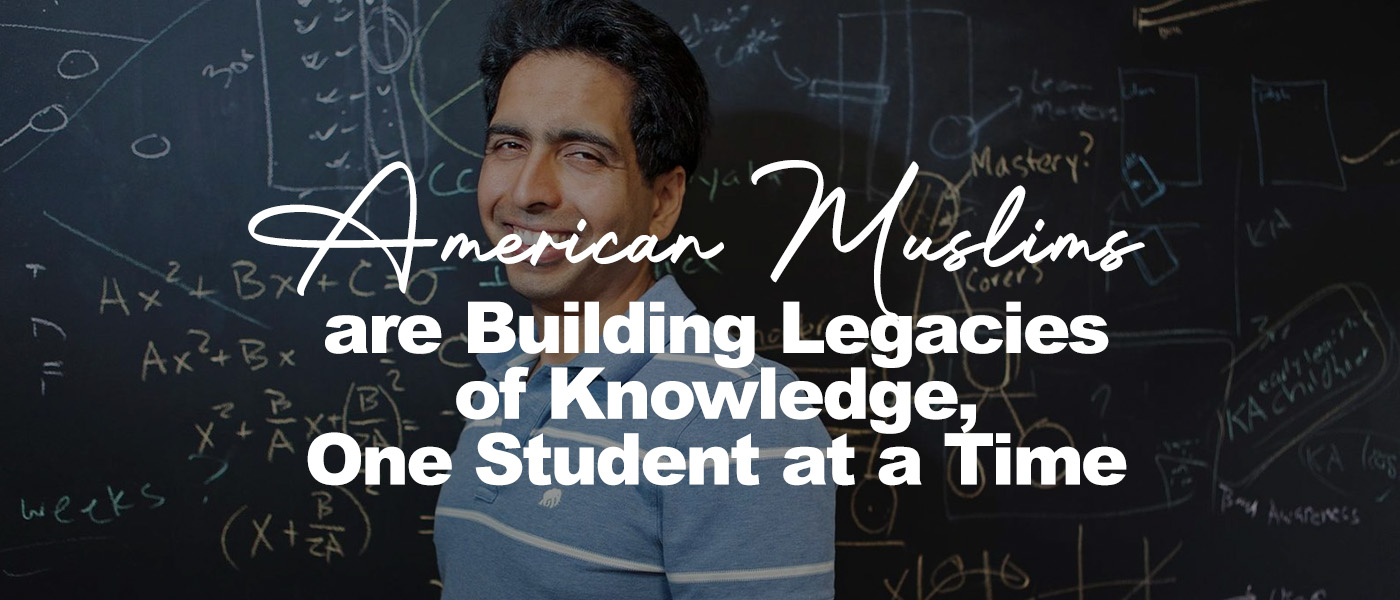
From Salman Khan’s global platform to Furqaan Academy’s classrooms, Muslim educators are shaping the future through faith-rooted learning.
There are moments in history when Allah (SWT) allows a single act of sincerity to ripple outward, touching lives far beyond what its originator ever imagined. These moments rarely announce themselves with fanfare, they begin quietly often in private homes, late nights, and long hours of unseen labor. They are born not from a hunger for recognition, but from a simple desire to help and for Muslims, this pattern is deeply familiar because our traditions are filled with individuals who have changed the world not through conquest or great acts for societal recognition, but through ilm, knowledge, that has been carried with humility and offered as a gift for the entirety of the ummah. The story of Salman (Sal) Khan, is a perfect personification of this in the modern era.
Known globally as the founder of Khan Academy, he is responsible for one of the most transformative educational movements of the modern era. His platform has reached hundreds of millions of learners across continents, languages, and socioeconomic boundaries. Children in underfunded classrooms, students in refugee camps, adults returning to school after decades, and even families learning together at kitchen tables out of sheer passion for education have all found enlightenment, confidence in subjects, and success through his noble work. Education, which was once locked behind a wall of tuition, geographical locations and even privilege, was now placed into the hands of anyone with an internet connection and a desire to learn more.
However, what is less often reflected upon is that Salman Khan is a Muslim, and he shows this prolific identity of his not just in his name, but through his ethos. His life’s dedicated work echoes the deepest values of our deen and that is that knowledge is sacred, teaching is a form of worship, and the truest measure of success lies in benefit to others. In an age where Muslims are frequently portrayed as reactive or peripheral to progress, his contribution stands as a quiet but powerful refutation. It reminds us that Islam has never been hostile to learning, innovation, or intellectual leadership. On the contrary, it was Islam that once lit the lamps of the world’s universities, preserved civilization’s texts, and transformed study into an act of devotion that would bring a person closer to Allah (SWT).
Just looking at the way The Quran was introduced to the Prophet (SAW) sets the tone on how invaluable education is to an individual. Allah (SWT) ordered Jibraeel (AS) to say to the Prophet (SAW), “Read, O’ Prophet, in the Name of your Lord—[…].” (The Clear Quran®, 96:1)

By ordering this to be the first command to the Seal of the Prophets (SAW), Allah (SWT) is emphasizing that faith and knowledge can never be separated. The path to Allah (SWT) would always be paved with reflection, curiosity, and understanding. The believer would be, by definition, a learner and would be a learner until the end of time. To be Muslim then, is to inherit a sacred relationship with education. We are the ummah of knowledge. We are the community whose Prophet (SAW) has said, “Whoever follows a path in pursuit of knowledge, Allah will make easy for him a path to Paradise.” (Sahih Muslim)

Yet, in our time, many Muslim communities find themselves struggling with educational inequity, fragmented systems, and a widening gap between potential and access. Brilliant minds are lost due to lamentable circumstances. Curiosity is shut down because it is too costly. Children internalize the lie that they are not good at learning when in reality, they’ve simply never been taught in a way that honors their pace and dignity. It is in this landscape that Salman Khan’s work speaks the loudest. His platform offers knowledge without gatekeeping, and has been designed to be as inclusive as possible.
This article reflects on his life, and serves as a reminder to Muslims on what happens when we combine our skills with public service. It is a reminder and call to action for Muslim educators, parents, administrators, and students to remember who we are meant to be. As you read this blog article, consider reflecting on the following questions:
- What would happen if Islamic institutions treated education as a commodity rather than an amanah from Allah (SWT)?
- What would change if we saw teaching as a form of sadaqah jariyah?
- What kind of ummah could we build if we believed, truly, that every child deserves access to excellence?
The establishment of Khan Academy, and the start of a quiet revolution
If someone were to study the origins of some of the world’s most influential educational institutions, they might expect to find people in flashy boardrooms, government grant honorees, or elite academic circles behind their success. However, the story of Khan Academy, a platform that has now reached hundreds of millions across more than 190 countries, began in a far less likely place, and that was a simple phone call between a cousin who needed help, and a young man who loved to teach. In 2004, Salman Khan, a Bangladeshi-Indian-American Muslim, was working in the world of finance in Boston. He received a call from his cousin to receive tutoring for a math subject. Wanting to make sure she understood the subject matter properly, he began to teach his cousin remotely.
To make the lessons easier to follow, he started recording videos and uploading them to YouTube just for her. They were short, clear, and spoken in a calm, non-intimidating tone, a style that would later become a hallmark of his teaching method. What happened next was something he never anticipated. Others began finding his videos, teachers began to use them in classrooms, and even parents began to write to him to explain how his videos helped their children succeed in ways that traditional classrooms hadn’t. Adult learners who had left academics long ago started to feel confidence in learning more subjects. Without any promotion, marketing, or business strategy, his YouTube channel became a place of refuge for struggling students and self-motivated learners alike.
The most empowering reflection to come out of this widespread recognition is that people no longer felt the pain or insecurities from feeling left behind, and the relief that came when someone, finally, explained things in a patient manner since everyone is on a different journey when it comes to academics. In 2009, Salman Khan made the decision to quit his job and dedicate himself full-time to building what would eventually become Khan Academy. At this point, many people began to question his decision. He was walking away from a prestigious, high-paying career to pursue an idea that had no revenue model, no institutional backing, and no roadmap, but Salman Khan believed that something greater was happening, and he trusted that the impact of making education accessible to everyone was worth the uncertainty.
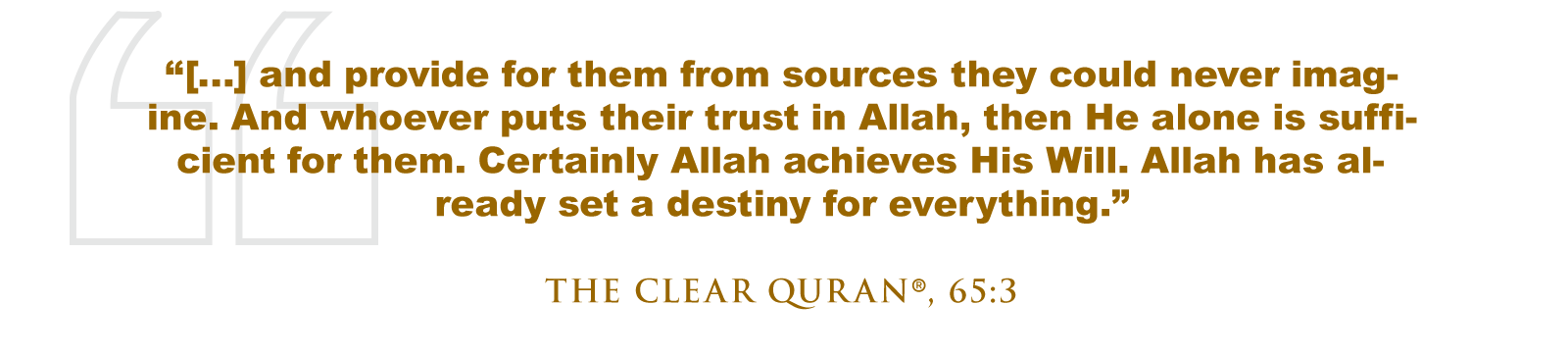
Allah (SWT) says, “[…] and provide for them from sources they could never imagine. And whoever puts their trust in Allah, then He alone is sufficient for them. Certainly Allah achieves His Will. Allah has already set a destiny for everything.” (The Clear Quran®, 65:3)
Today, Khan Academy offers over 70,000 practice problems, 13,000 instructional videos, and curriculum support in multiple subjects, including math, science, economics, computing, and test prep all for free, for anyone, and anywhere. It has been used in classrooms, homeschool networks, underserved communities, and refugee camps. It has helped children with learning disabilities, adults pursuing second chances and even educators looking for better ways to teach. However, perhaps most powerfully, Khan Academy has restored something that too many students have lost, and that is the belief that they are capable of learning. In a world where students are often ranked, labeled, and filtered out based on standardized tests and fast-paced classrooms, Salman Khan’s approach sends a different message, and that is, everyone has worth in education.
Our Prophet (SAW) has said, “The best of people are those who are most beneficial to others.” (al-Mu’jam al-Awsat)

How a Muslim man became the center of global education
In a world where Muslims are often spoken about rather than listened to, and where our stories are too frequently filtered through the language of fear, crisis, or controversy, the presence of a Muslim quietly shaping how millions of people learn is not just refreshing, it is transformative. Salman Khan does not appear on television as a religious figure, nor does he introduce his work through Islamic terminology, yet his influence reaches classrooms, homes, and communities across the globe, and with every lesson watched and every concept understood, a different narrative about Muslims is being written. This kind of representation matters far more than we often realize.
For Muslim students growing up in Western societies, success is frequently framed as something that exists outside of them. Excellence is shown with faces that rarely resemble their own. Innovation is modeled by people whose values and identities seem distant. Over time, this quiet absence sends a powerful message, and that is that Muslims are not central to progress, that they exist on the margins of intellectual life, and that leadership in fields like education, science, and technology belongs to “others.” Then, when a child opens Khan Academy and sees that there is a name that sounds quite like theirs, a quiet thought emerges, “maye I belong here too.”
Allah (SWT) tells us, “And so We have made you believers an upright community so that you may be witnesses over humanity and that the Messenger may be a witness over you […].”
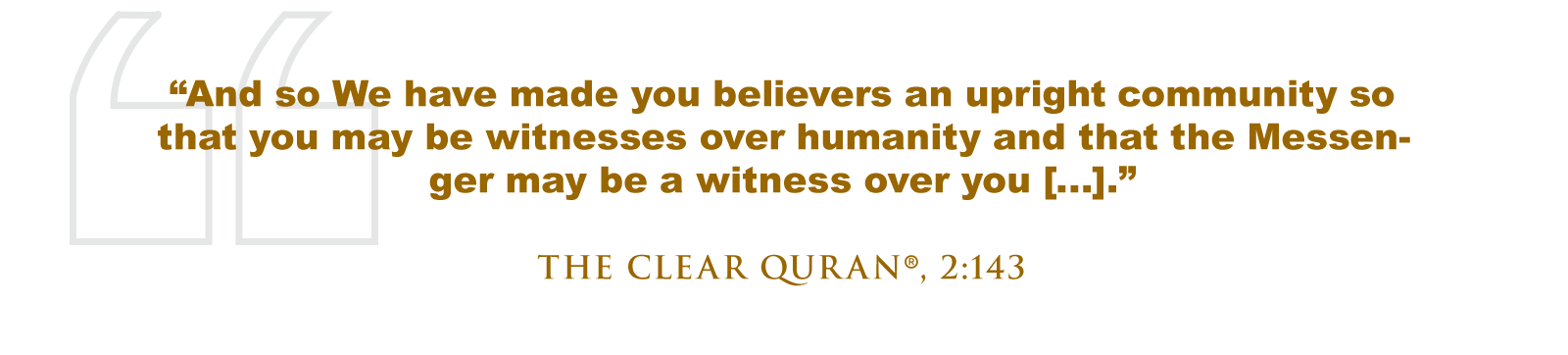
(The Clear Quran®, 2:143)
Khan Academy now partners with school districts, governments, and international organizations. It is used in elite private schools and underfunded public classrooms alike. It supports students preparing for college entrance exams and adults learning basic numeracy for the first time. It reaches across borders, cultures, and languages, offering the same dignity to every learner. This is a great stepping stone for our Muslim youth as well. A generation raised in an environment where Muslims are rarely seen as leaders in knowledge internalizes that absence, however, a generation that sees a Muslim shaping global education begins to imagine a different future.
It also reminds Muslim educators that our influence does not have to remain small or local! It challenges our institutions to think beyond the classrooms, and towards real impact. It calls on parents to raise children who see knowledge not only as a means of personal success, but as a responsibility to others.

Ilm is the nucleus of Islam
If we were to ask what truly lies at the heart of Islam, we would find that one of the clearest and most constant answers throughout The Quran, Sunnah, and centuries of Muslim civilization is knowledge. For us Muslims, knowledge is a way of life, it is a continuous journey of learning, reflection, and teaching that brings a believer closer to Allah (SWT), strengthens the ummah, and benefits humanity at large. In fact, scholars throughout Islamic history have emphasized that the status of knowledge in Islam is unlike that of any other system of belief or way of life. It is not simply encouraged, it is honored, protected, and rewarded in ways that elevate it to a core act of worship. It is the one virtue upon which every other Islamic duty depends on because without knowledge, nothing else in the religion can be truly understood or properly practiced.
The great scholar Imam al-Shafi’i has said, “Seeking knowledge is more virtuous than optional acts of worship.”
Why, and how could this be? Because knowledge is what leads a person to worship Allah (SWT) correctly and sincerely. It protects a person from ignorance, superstition, and blind imitation. It gives clarity where there is confusion. It replaces inherited habits with intentional actions, and most powerfully, it turns the mind into a tool for understanding the world through the lens of divine truth. This is why the Prophet (SAW) did not only teach his companions what to do, he taught them why, how, and with what intention. He created a generation of people who were not only obedient, but intellectually grounded in the purpose behind their actions.
From the earliest days of the ummah, the pursuit of knowledge was held up as one of the most honored responsibilities in society. The Prophet (SAW) said, “Whoever follows a path in pursuit of knowledge, Allah will make easy for them a path to Paradise.” (Sahih Muslim)

He said in another hadith, “The scholars are the inheritors of the prophets.” (Sunan Abi Dawud)

In the Islamic Golden Age, which stretched from Baghdad to Cordoba and beyond, was not just a period of scientific achievement. It was an expression of this very religious duty. Muslims preserved ancient texts, developed new disciplines, and built institutions like Bayt al-Hikmah in Baghdad and al-Qarawiyyin in Morocco (the oldest continuously operating university in the world). All of this was as an extension of faith, not separate from it. As a result, subjects like physics, medicine, astronomy, and mathematics were studied in the same breadth as The Quran and hadith because they were seen as part of Allah’s (SWT) signs in creation. In our time, however, this legacy of education seems to be at risk.
Too many Muslim communities around the world are struggling with broken education systems, overwhelmed schools, rising tuition, and shrinking resources. In some cases, parents have also lost confidence in what Islamic schools can offer. In others, young Muslims are turning away from intellectual life altogether, not because they lack intelligence, but because they were never nurtured in environments that made learning feel empowering. This is why, what Furqaan Academy represents in our time is not simply a school offering Islamic studies or standard academic instruction, it is a living reminder of what Islamic education was always meant to be a place where hearts and minds are nurtured together, where knowledge is not limited to facts but connected to purpose, and where every child is seen as an amanah from Allah (SWT).
In many ways, Furqaan Academy is an answer to the silent crisis we often overlook, and that is the crisis of Muslim children growing up unsure of their place in the world, torn between cultures, and often disconnected from the richness of their own faith. It is a place where students are taught that they are not behind, not incapable, not defined by what they lack, but empowered by who they truly are. Without institutions like Furqaan Academy, we risk raising a generation disconnected from their roots, but with them, we plant seeds that will grow them into leaders not only in the ummah, but in the world. Without knowledge, there is no growth. Without education, there is no leadership, and without a revival of Islamic learning, rooted in love and led by sincerity, there can be no future worthy of our past.
Furqaan Academy is the best investment for this world and the next
When we think of leaving behind a legacy as Muslims, we often imagine big, visible deeds such as building a masjid, digging a well, giving a large donation, or raising a righteous child. However, the Prophet (SAW) gave us a broader vision, and that is a timeless formula for how the believer can continue earning rewards even after they return to their Lord. The Prophet (SAW) says, “When the son of Adam dies, all his deeds come to an end except for three: ongoing charity, beneficial knowledge, and a righteous child who prays for them.” (Sahih Muslim)
These three are not separate. In fact, at places like Furqaan Academy, they come together in one living, breathing form. Because what is Furqaan Academy if not a place where beneficial knowledge is shared every day? What is a righteous child if not the product of years of faith-based learning, mentorship, and love? And what is a school, built and sustained by the generosity of a community, if not one of the most powerful forms of ongoing charity?
When you support a school like Furqaan Academy, whether by funding a scholarship, sponsoring a program, donating Quran copies or books, paying a teacher’s salary or simply volunteering your time, you are planting seeds in a soul that never dries. Every lesson taught, every verse memorized, every act of kindness passed from teacher to student, becomes part of your scale of good deeds. Even years later, long after a student has graduated, their prayers, their character, their dawah and even the knowledge they pass on to others becomes a part of your reward.
It is easy to admire an Islamic school from a distance, but it is much harder to realize that its survival and strength depend on all of us. Furqaan Academy cannot flourish on tuition alone. It cannot fulfill its mission without sustained support from believers who recognize that building and maintaining an Islamic school is not a burden, it is an opportunity. A chance to give not just to the school, but to your akhirah. This mindset shift is essential. Too often, we give only when there is a crisis. We react to emergencies, but hesitate when asked to fund long-term projects like Islamic education.
Allah (SWT) says, “The example of those who spend their wealth in the cause of Allah is that of a grain that sprouts into seven ears, each bearing one hundred gains. And Allah multiples the reward even more to whoever He wills. For Allah is All-Bountiful, All-Knowing.” (The Clear Quran®, 2:261)
In every student who recites a verse, solves a problem, or makes dua in the quiet of their heart, there is a chance for ongoing reward, and on the Day of Judgment, when all worldly success fades away, it may be that the most lasting thing we left behind was a child who learned to love their deen because of a school we helped build and sustain.
Dua
اللَّهُمَّ إِنِّي أَسْأَلُكَ عِلْمًا نَافِعًا، وَرِزْقًا طَيِّبًا، وَعَمَلًا مُتَقَبَّلًا
Allahumma inni as’aluka ilman nafi’an, wa rizqan tayyiban, wa ‘amalan mutaqabbalan
“O Allah! I ask You for beneficial knowledge, pure sustenance, and deeds that are accepted.” (Sunan ibn Majah)
Ameen!